
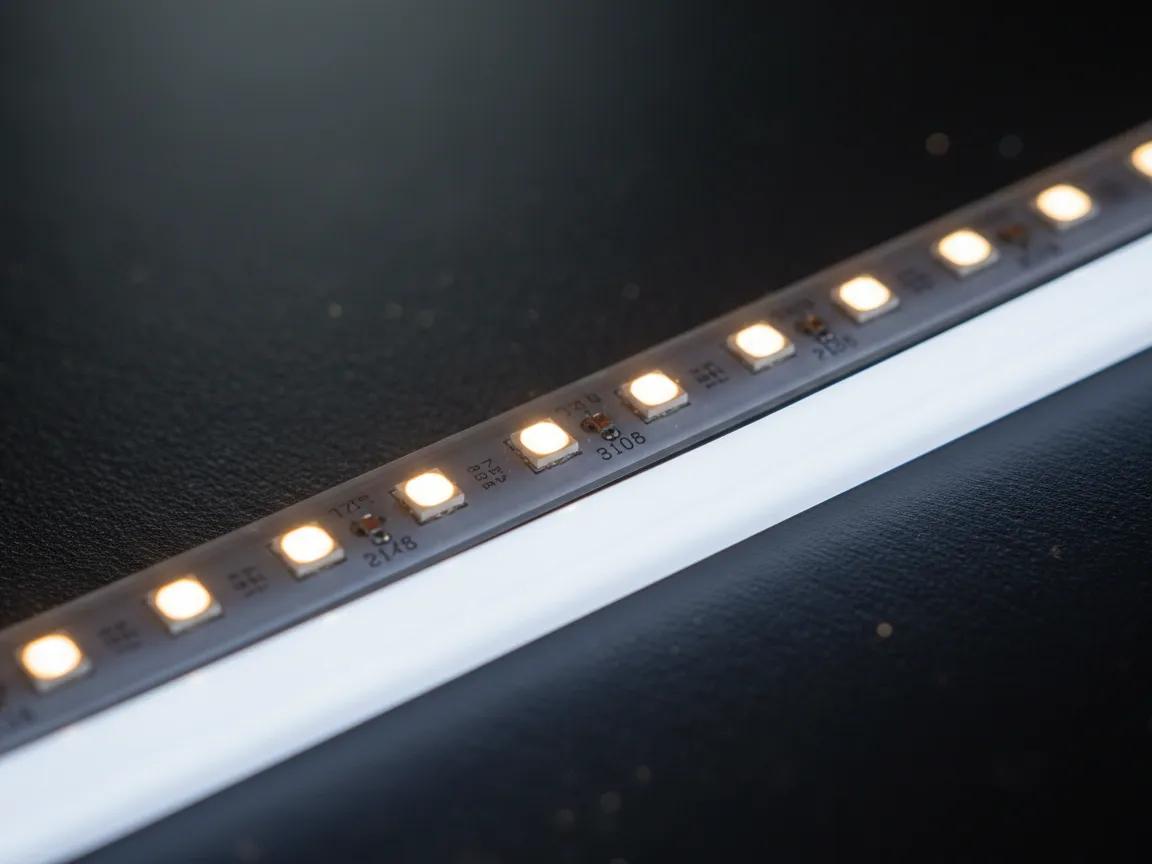
Ask two electricians which reel to specify and you will often get two answers. The cob led vs smd led question lands in our inbox almost every week, usually somewhere between a kitchen plinth and a full commercial fit-out. Both families light the same room; they just arrange the leds in a different way. COB and SMD are two distinct packaging technologies for leds, and the packaging technology is what decides how the finished line of light reads to the eye, how warm it runs and what it costs to keep on. Get that part right and the rest of the specification tends to fall into place: profile, driver, diffuser.
Key differences between cob and smd led strips
The table below covers the main differences you will actually notice on site. Datasheet trivia is left out.
| COB led strips | SMD led strips | |
|---|---|---|
| Density | 480 to 896 leds per metre | 30 to 180 leds per metre |
| Appearance | dot-free, uniform light | dots visible without a diffuser |
| Beam angle | up to 180 degrees | 120° to 160° per diode |
| Typical draw | around 10 watts per metre | 14.4W/m on a 120 led/m reel |
| Colour options | single colour, CCT, tunable white | single colour, CCT, RGB, RGBW, RGBCCT |
| Repairs | affected section replaced | individual led packages can be replaced |
| Rated life | 30,000 hours and up | 30,000 hours and up |
Everything in that table follows from one decision: whether each emitter sits inside its own housing, or whether many of them share a single continuous coating. Once you can picture that difference, the rest of the comparison is mostly consequence.
SMD led strip lights explained
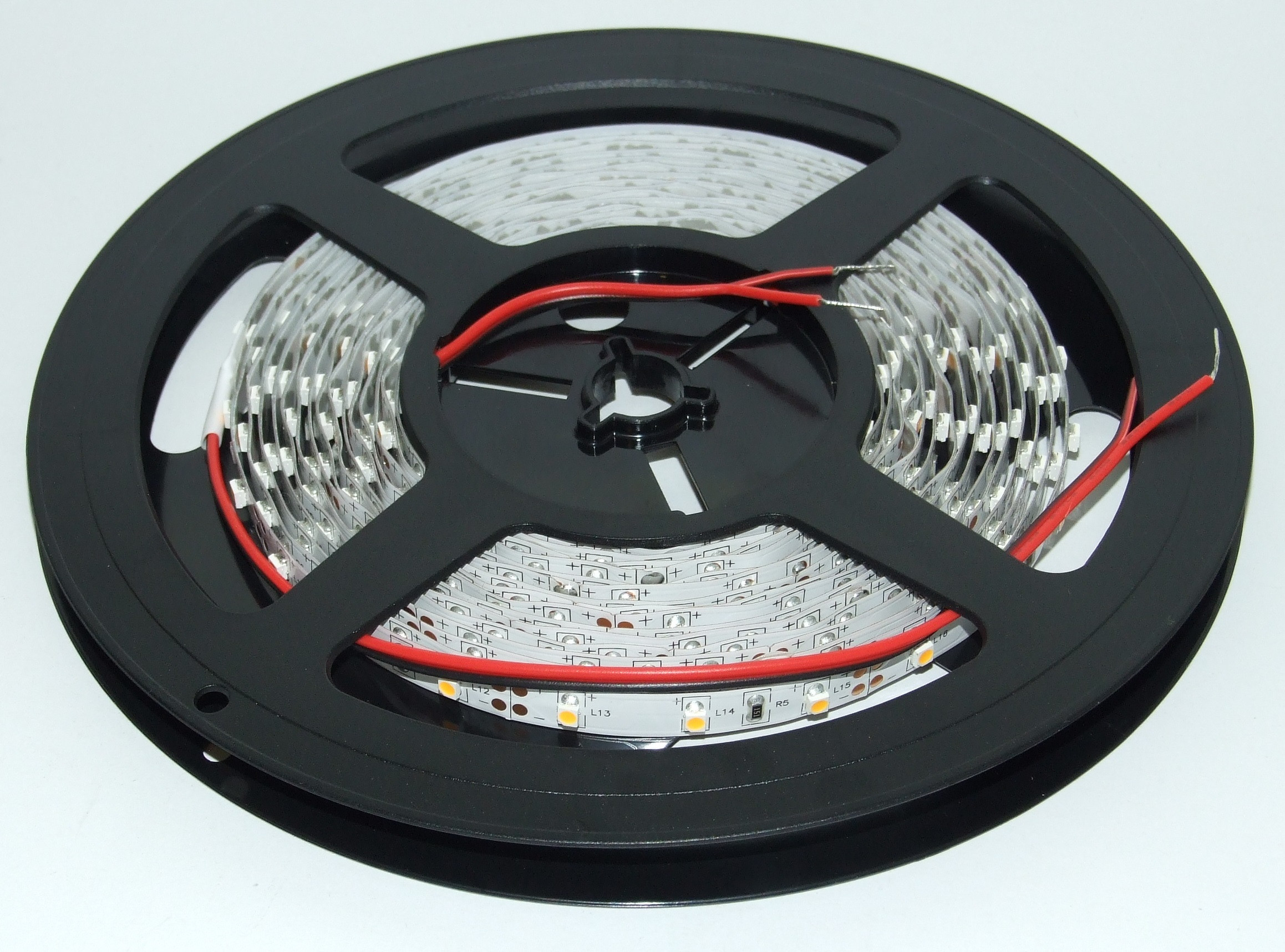
SMD stands for surface mounted device. Each surface mounted diode is a self-contained package soldered onto a printed circuit board, and the four-digit code on the reel gives its footprint in millimetres – a 5050 measures 5.0 mm square, a 2835 measures 2.8 by 3.5 mm. Smd leds are the most common type of led used in consumer and commercial lighting, which is why they are still the default line on most wholesale price lists and the benchmark against which every other format gets judged.
Because every smd surface mounted package works independently, smd leds offer a versatility that a shared coating cannot match. Housings such as the 5050 RGB hold red, green and blue emitters side by side, so one reel covers RGB, RGBW and RGBCCT scenes. That flexible design is also why smd led strip lights arrive in so many configurations and colours, from 2700K through to 6500K and tunable CCT, and why individual led packages can be replaced instead of scrapping a whole run. On a long commercial installation, that serviceability is worth real money.
The trade-off is visible dots. Diodes sit at intervals of 30 to 180 leds per metre, each throwing a 120° to 160° cone, so across a polished worktop you read a row of highlights rather than a line. Denser smd leds help: 180 leds per metre sit closer together than 60 leds per metre, so the highlights blur sooner. A deeper aluminium profile with an opal diffuser fixes it properly, and it is the reason smd strip lights want more mounting depth than most people plan for. Budget for the channel at the design stage, not after the joinery is fitted.
COB led strip lights explained
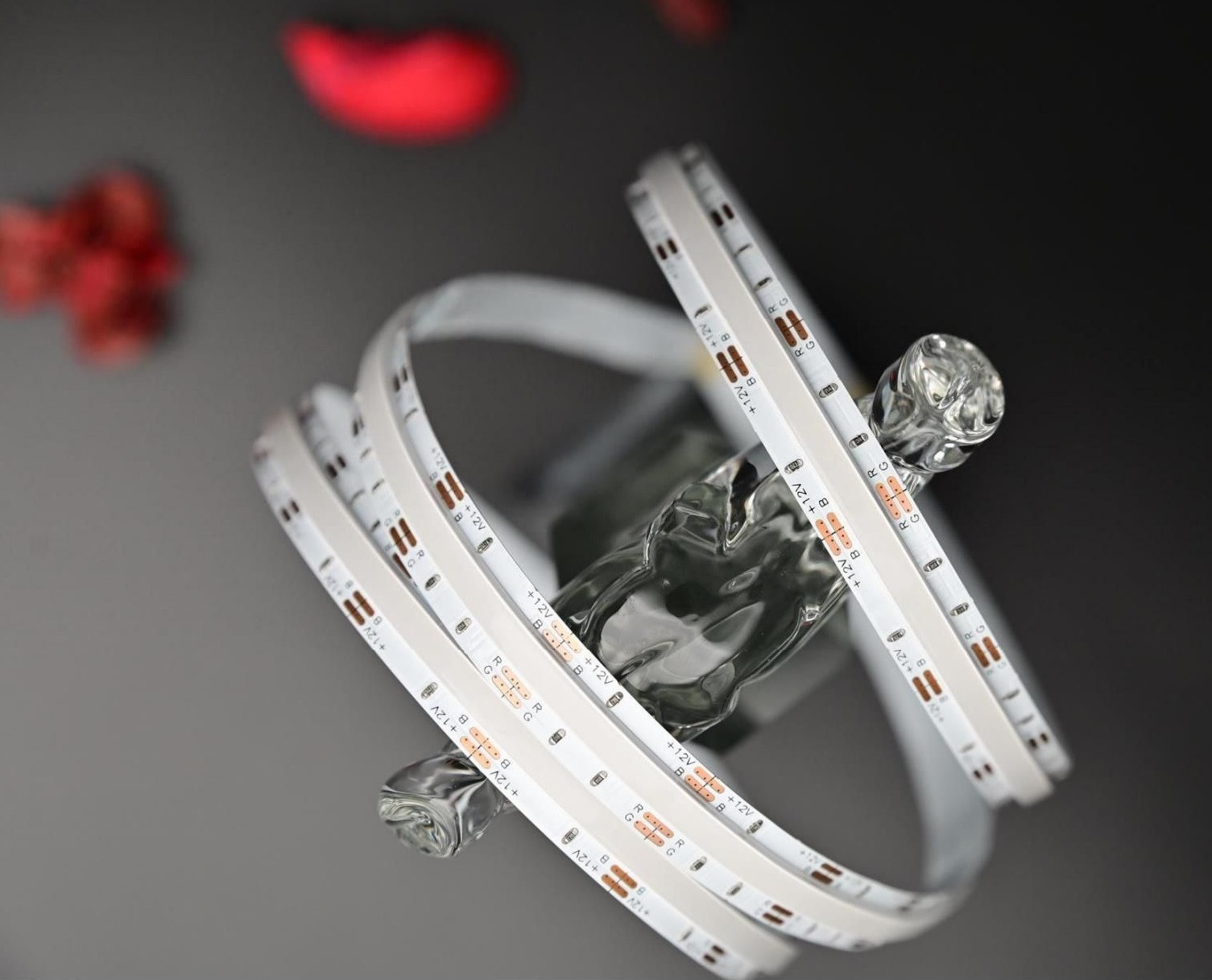
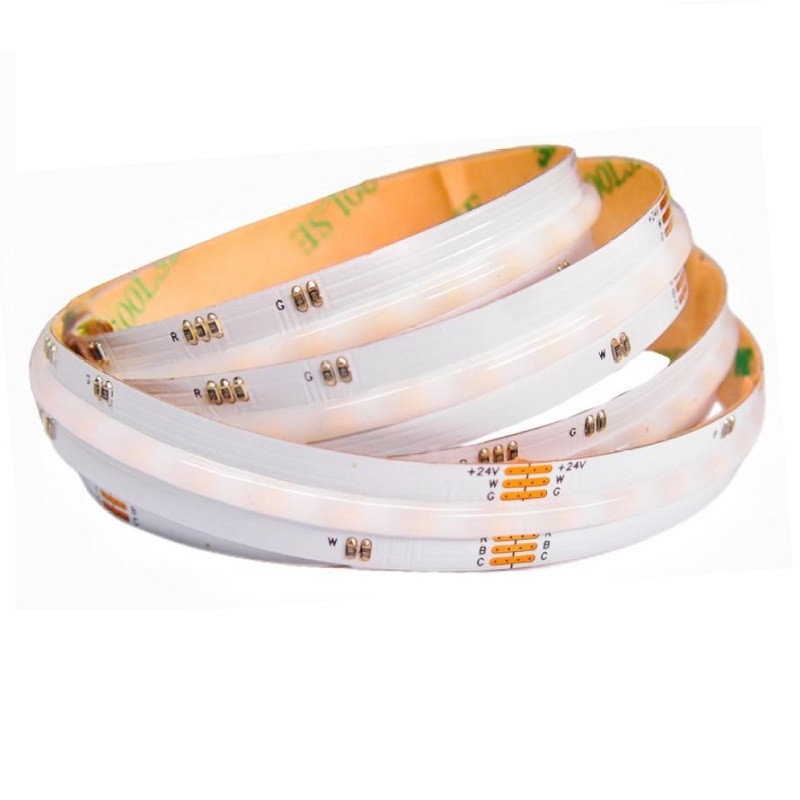
The cob chip on board approach drops the individual housing altogether. Multiple led chips are mounted directly onto a thermally conductive substrate of ceramic, metal or silicon carbide, then covered by one continuous phosphor layer. Cob leds therefore reach a far higher density: 480 leds per metre is standard, and dense reels run up to 896 leds per metre. Losing the lead frames and intermediate solder joints also removes a long list of potential failure points.
That density is what produces the smooth looking light people buy cob led strip lights for. With no gaps between small led chips, cob leds deliver uniform light with no visible hotspots – straight onto granite, tiles or glass shelving, with no diffuser doing the smoothing for you. A white cob reel in a 7 mm channel under a wall unit lays a clean, shadow-free band across the worktop, which is exactly the effect that sells a handleless kitchen.
Tight colour consistency across a dense array is the harder part of cob manufacturing, since sorting happens after the coating goes on, not before board assembly. Ordering cob light strips from a single production batch keeps a long run visually consistent, so ask about batches before you split an order across two deliveries.
Brightness, beam angle and light output
On efficiency, cob leds win. On datasheet figures, cob led strips produce up to 40% more light per watt. A typical cob strip draws around 10 watts per metre, high-output reels up to 19W, where a 120 led/m smd strip consumes 14.4W and outputs 1012 lumens. At the same wattage, cob leds therefore put noticeably more usable light output on the surface. Across a 20 m perimeter that gap shows up on the bill, because smd led strips use more energy for the same result.
Brightness is a separate question from energy efficiency. Each package has its own thermal route and can be driven hard, so smd leds can achieve higher brightness and greater intensity with superior light projection – useful wherever the light has to travel, in high bays or deep coves. Cob strip lights sit at moderate brightness and concentrate it instead: many lumens from a compact area, which is why cob leds also dominate downlights and track lights. Count the leds and read the wattage together, because neither number tells you much on its own.
The wider beam angle belongs to COB. A continuous coating spreads output across up to 180 degrees, so cob lights read as one band from almost any viewing position. Smd leds hold a tighter cone per diode, up to 120° to 160°, which throws further but puts every diode on show. Compared with the led lights either format replaced a decade ago, both are a long way ahead on lumens per watt.
Heat management, energy efficiency and lifespan
Thermally, the two work in opposite directions. With the emitters sitting on the substrate, COB has a direct thermal path for heat dissipation – no lead frames and no solder joints in the way. Dozens of junctions in a narrow line still generate more heat per centimetre than a sparse reel, so a cob strip belongs inside an aluminium profile acting as a heat sink, never stuck straight to plasterboard.
Modern packages such as the 2835 and 3014 build a small thermal pad into the housing, while traditional led packages like the 3528 and 5050 rely on the copper of the board alone. That per-package route is what lets a driver push more current for higher lumens, and better heat management is exactly why smd leds can be run brighter than their footprint suggests. Push too far and junction temperatures climb, and output falls away years early.
Both technologies are rated at 30,000 hours as a floor, and better reels are quoted at 50,000. Do COB LEDs last longer? As a rule yes, and cob led strips hold their output better late in life, because dissipating heat through a shared substrate beats pushing it through 60 separate solder pads. Smd leds are also more prone to damage, because every diode is an exposed component: a knock during installation or a cut through the wrong point takes out a segment. The shared encapsulation resists physical damage better, though it also means a fault gets repaired by the section, not by the diode.
Either way, a driver matched to the reel is what protects a long lifespan. Pick a constant current unit for modules that ask for it and a stable constant voltage power supply for standard 12V or 24V strip lights, and leave headroom rather than running at the limit. Voltage drop is the other quiet killer on long runs: feed anything past 5 m from both ends, or your led lights will sit visibly dimmer at the far end than at the near end.
Where cob and smd led strips work best
The two split cleanly by application. Cob led strip lights are the choice for decorative installations and direct-view architectural lighting: shallow channels under 10 mm, handleless cabinet reveals, stair nosings, mirror surrounds – anywhere the line of light itself is the detail. Smd technology is ideal for general ambient lighting and flexible strips, so ceiling coves, drop valances, kick-plates, perimeter runs and IP-rated outdoor applications where the leds hide behind a deep diffuser.
Surface mounted reels also excel in task lighting and architectural features that need colour, from retail displays to garden schemes on a scene controller. And for professional installers pricing a large job, cost effectiveness still favours smd led strips per metre – although the deeper profile and diffuser needed to hide the dots narrow that gap more than the reel price suggests. Price the channel and the strip together and the two options usually land closer than expected.
- Shallow channel, strip on show: cob light strips in an aluminium profile sized for the reel.
- Concealed cove, or colour that changes: smd led strips behind an opal diffuser.
- Size the LED driver with 20% spare capacity. Either format, every time.
Which is better, smd or cob led?
Neither wins outright. The better choice comes down to whether anyone sees the source: if the strip is visible or sits close to a reflective surface, choose cob leds. If you need colour change, maximum throw or the lowest cost per metre, choose smd leds. For a domestic kitchen we would specify the dot-free reel almost every time, because the price gap closes the moment you cost up the deeper channel needed to hide dots. Both sets of leds will outlive the joinery they are fitted to, provided the thermal side is handled.
Three questions get you to an informed decision on cob vs smd. How deep is the channel? Will the strip be seen? Does the scheme need colour? Answer those and the reel picks itself, whichever led technology you land on.
We keep both led strips in stock alongside the profiles, diffusers and drivers that make either one work properly, and we ship worldwide from the UK with no waiting on back orders. If you are still weighing up cob vs smd led for one awkward detail, send the section drawing over – our team will tell you which reel we would use, and why.