
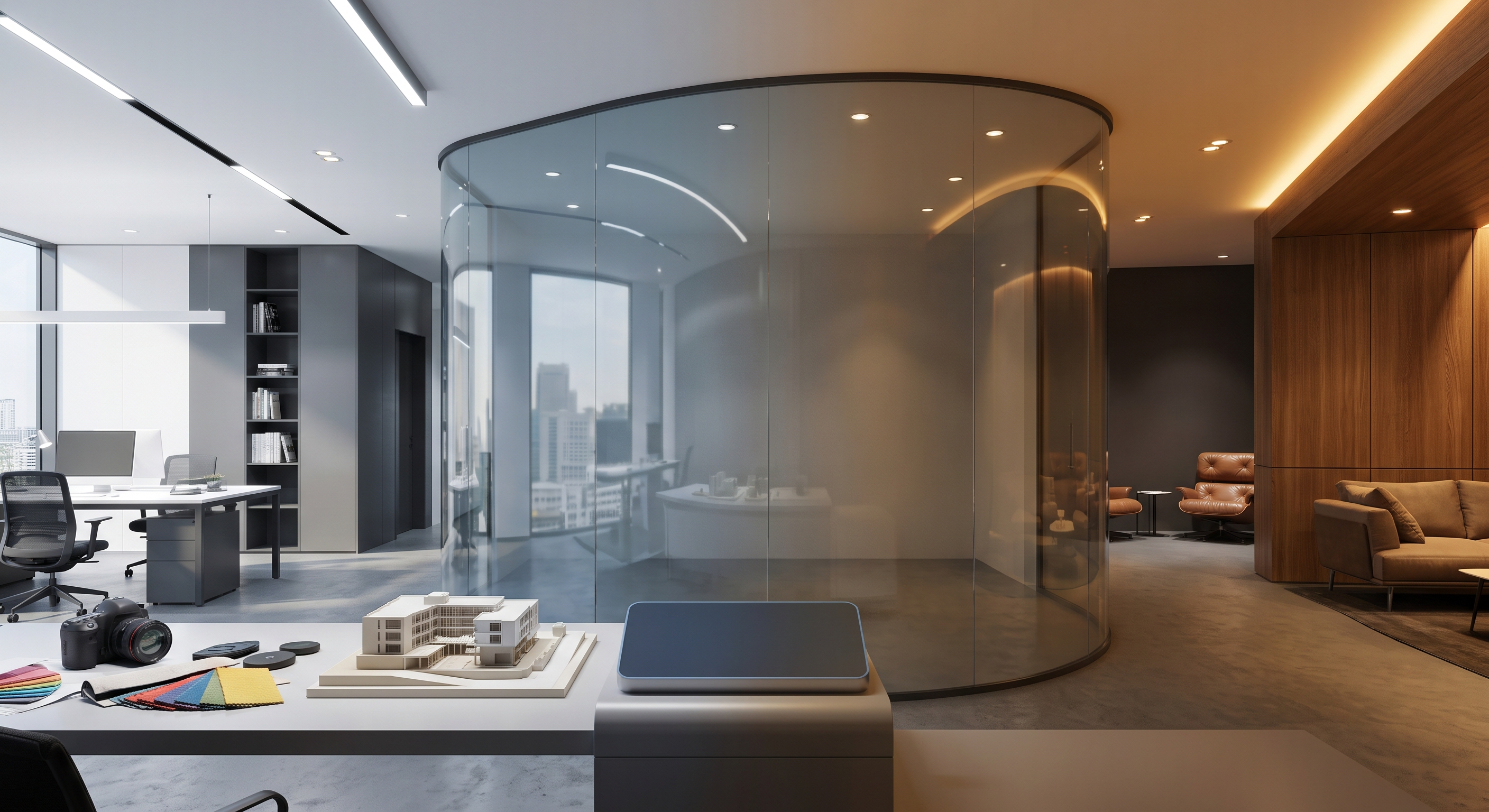
Dynamic lighting has completely reshaped how we design modern spaces. Whether you’re fitting out an open-plan office, an architectural residential build, or a retail display, Tunable White (CCT) LED strip is usually the go-to solution. The goal is simple: recreate the natural progression of daylight indoors to support circadian rhythm and visual comfort.
However, if you’ve ever installed a standard 2-channel CCT strip and noticed something felt slightly “off” at mid-range temperatures-say around 3500K to 4000K-you aren’t imagining things.
Here is what is actually happening beneath the phosphor coating, why standard linear mixing struggles, and how green spectral correction is fixing modern dynamic lighting.
The Physics Flaw: Straight Lines on a Curved Spectrum
Most entry-level CCT systems use a simple 2-channel setup: Warm White (e.g., 2700K) paired with Cool White (e.g., 6500K). The controller simply dims one channel while ramping up the other.
On paper, this sounds logical. On a CIE chromaticity diagram, it exposes a major problem:
- The Black Body Locus (Planckian Curve): Natural sunlight and black-body radiation follow a distinct curve as temperatures change from warm amber at dawn to crisp white at midday.
- The 2-Channel Mixing Line: When you mix two discrete LED emitters, the resulting light path is a straight line drawn between the two points.
Because the line cuts underneath the curve, the mid-range color points suffer from a negative Duv shift. In practice, this means your 4000K neutral light gets pulled toward a washed-out, unnatural pink or magenta tint rather than a clean, neutral white.
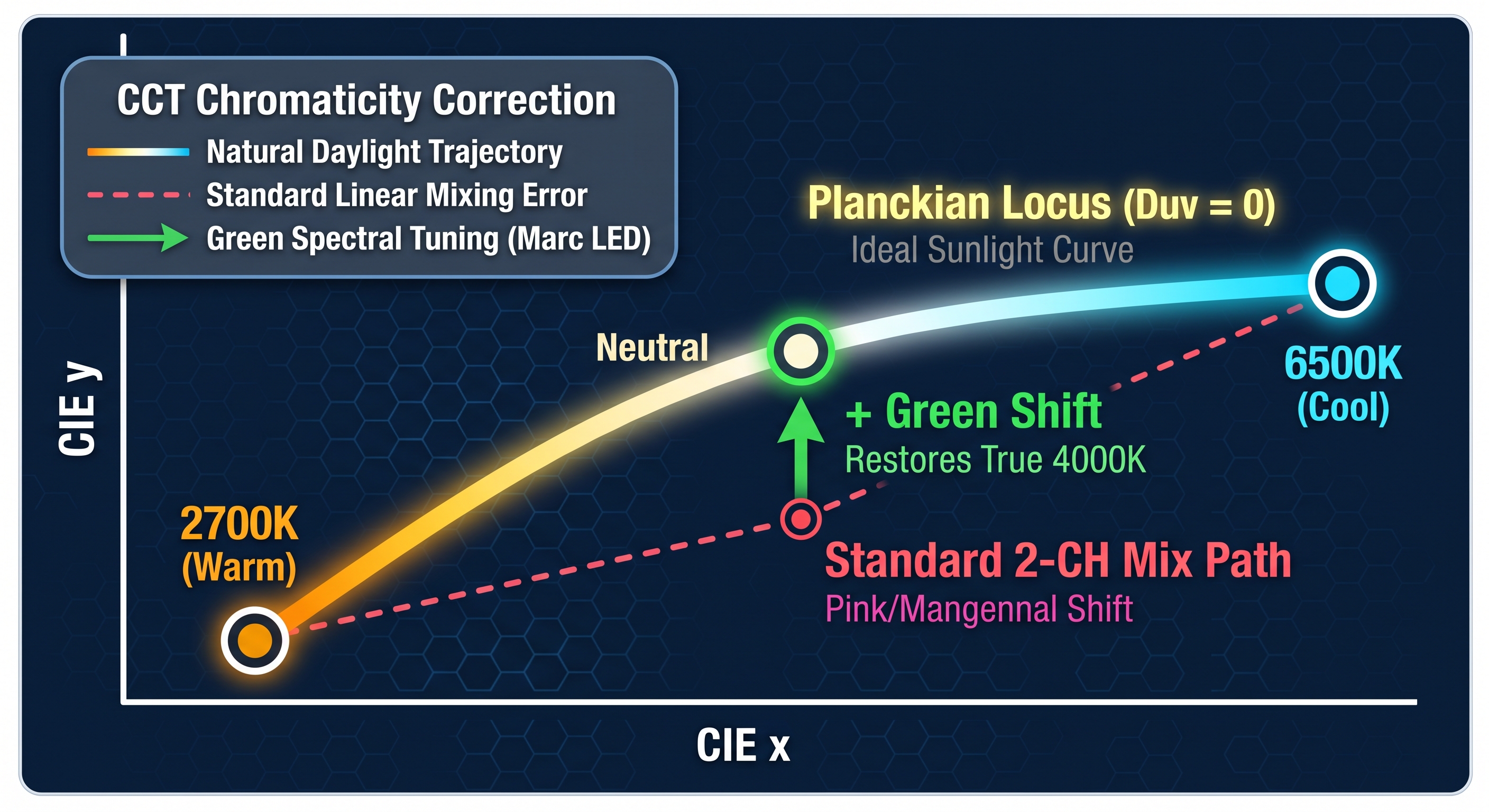
Why standard 2-channel LED tape deviates from the natural Planckian curve at mid-range temperatures, and how green spectral tuning restores true chromaticity.
Enter Green Correction: Putting Light Back on Track
To solve the mid-range drop, advanced multi-channel systems introduce targeted green (or mint-green) spectral tuning.
By blending a small, calibrated dose of green light into the mix as the strip transitions between warm and cool, the chromaticity point is pushed back up directly onto the Planckian locus (Duv 0).
What does this change in the real world?
- Zero pink/violet tinting: Transitions remain crisp, clean, and authentic across the entire dial.
- True CCT accuracy: When you dial in 3500K or 4000K on your controller, you actually get pure daylight white rather than a compromised approximation.
- Seamless architectural integration: When washing light over white walls, timber, or light stone, the surfaces retain their genuine textures without artificial color casts.
Better CRI and Real-World Visual Performance
Green correction isn’t just about tweaking the color temperature-it fundamentally improves the Spectral Power Distribution (SPD) of the fixture.
1. Fuller Spectrum, Superior Color Rendering (CRI / TM-30)
Standard 2-channel mixing often creates dips in the spectrum, particularly in the cyan-green transition zone. Adding green spectral energy fills these troughs, boosting both general Ra and deep color fidelity (R9 for rich reds, R13 for skin tones). In retail or hospitality settings, this means fabrics, food, and faces look lively rather than flat.
2. Scotopic Efficacy: Brighter Light at Lower Wattage
The human eye perceives light differently depending on ambient light levels. Our rod cells-which govern peripheral and low-light vision-peak in sensitivity around 507 nm (the green-cyan spectrum).
By enhancing the green portion of the spectrum, you improve the S/P (Scotopic/Photopic) ratio. The practical takeaway? Spaces feel brighter, clearer, and more comfortable to the human eye without having to pump up the overall wattage.
How to Get Dynamic Lighting Right on Your Next Build
If you are designing a project around human-centric lighting or simply want flawless white light that shifts without distortion, hardware selection matters:
- Use Multi-Channel Drivers: Look for smart DALI-2, Zigbee, or multi-channel DMX controllers capable of handling multi-point color mixing curves rather than raw linear fading.
- Pair with High-CRI LED Tapes: Ensure your base white diodes already feature high color rendering (Ra>90/95).
- Plan Your Aluminum Profiles & Diffusers: To ensure individual diode wavelengths blend smoothly before exiting the luminaire, always mount dynamic strips in suitable deep-channel LED extrusions with frosted or opal diffusers.
Looking to Upgrade Your Architectural Lighting?
At Marc LED, we supply professional-grade LED strips, high-CRI multi-channel tapes, premium aluminum profiles, and smart control gear designed for seamless dimming and color tuning.
Browse our range of CCT LED strips, controllers, and power supplies at Marc LED or reach out to our technical team for assistance with specifying your next residential or commercial project.