
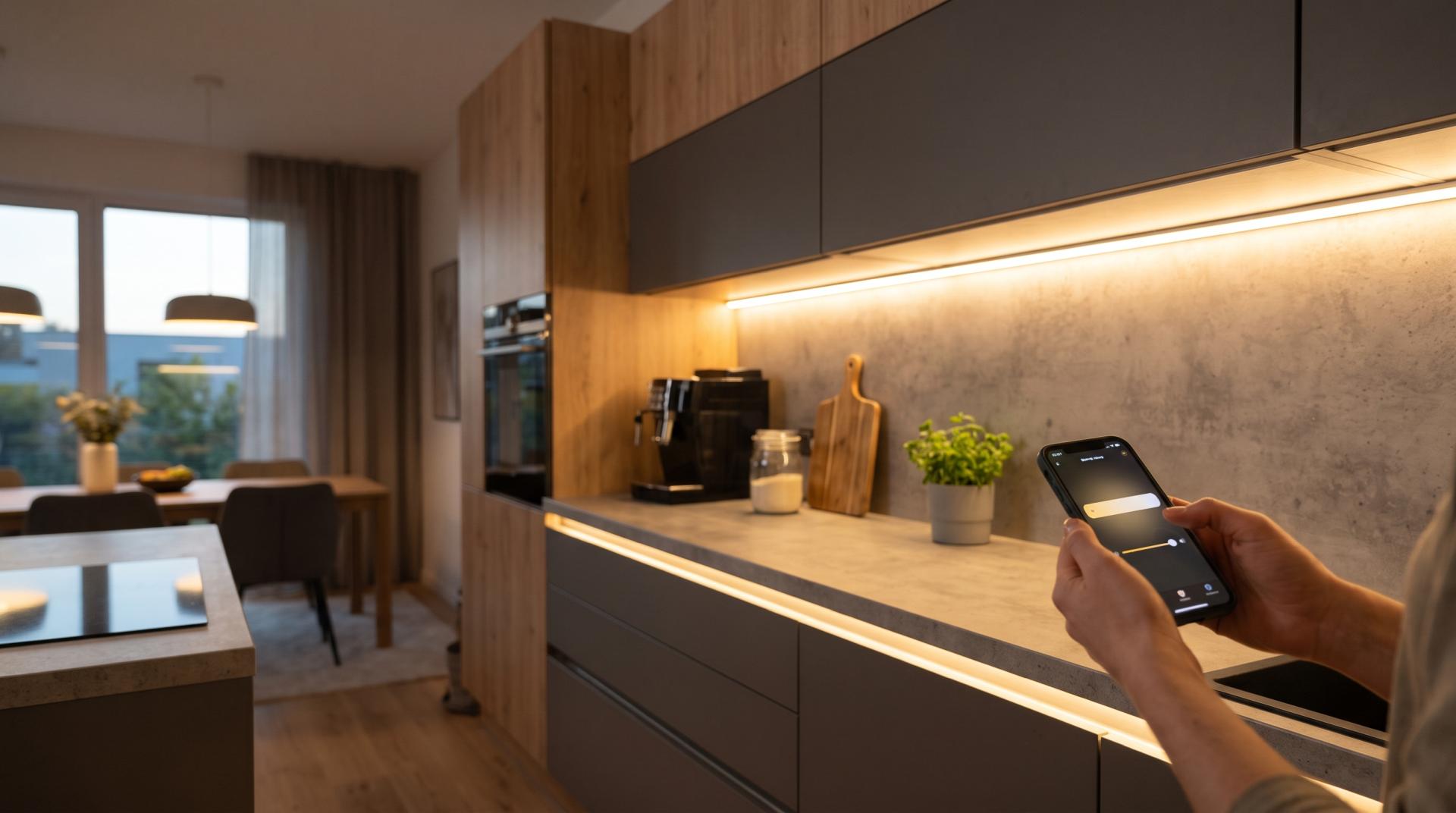
Once the strip, profile and driver are chosen, running costs are usually the next question. So, do LED strip lights use a lot of electricity? No. A typical LED strip draws around 5-15W per metre, so a 5m run under kitchen cabinets needs less power than one old 100W incandescent bulb. LED strip lights are extremely energy efficient, but the final figure depends on length, density, brightness and the power supply you install.
How Much Electricity Do LED Lights Use per Metre?
A strip’s power draw is set by its wattage per metre (W/m), typically shown on the reel label, the packaging or the product page. LED light strip wattage per metre varies between products, depending on specifications such as chip type, size and density. Here are a few examples from our range:
- 24V SMD2216 tape, 1800K, with 60LED/m: 4.8W/m
- 24V SMD2835 tape, 4000K, with 100LED/m: 8.4W/m
- 24V COB tape, 2200K: 18W/m
Multiply W/m by length to get the total power usage. Five metres of 8.4W/m tape draws 42W. Use this total to calculate running costs and choose the right driver.
What Affects LED Strip Light Power Consumption?
The main factors that affect LED power consumption are length, density, brightness, colour and the components between the mains and the strip.
Length and LED Density
Each metre of tape adds its W/m rating to the total, so a 10m run uses twice the power of a 5m one. LED density is another factor: the more LEDs per metre, the higher the wattage per metre. Standard tapes typically carry 30-180 separate LEDs per metre, spaced along the strip. On COB (chip-on-board) tapes, hundreds of tiny chips, up to 896 per metre in high-output products, sit under a continuous coating, so they give an even line of light with no visible dots.
High-density LED strips and COB tapes draw more power per unit length than standard-density tapes, but they also give more light. In short, power consumption rises roughly in step with light output.
Learn more about different types of LED tape on our blog: COB vs SMD LED Strips: Which One Should You Actually Buy?
Brightness, Colour Temperature and Colour Channels
Dimming LED lights is the easiest way to reduce power consumption: a strip dimmed to 50% draws roughly half its rated power. Colour temperature doesn’t change the rated wattage: cool white LEDs need slightly less energy for the same brightness, but the difference is too small to show on your electric bill.
Colour-changing tapes work differently. RGBW and RGBCCT strips have separate channels for red, green, blue and white light, so they have varying power consumption: the rated W/m assumes every channel at full output, while a single colour uses only part of it. Size the driver for the full rating, but expect lower running costs in everyday use.
Drivers, Controllers and Wiring
The driver converts 230V mains into 12V or 24V DC and loses some energy as heat. Quality units can reach 90% efficiency or more, while cheap ones often waste more energy. Keep in mind that the rating isn’t the whole story: the driver also needs to suit your strip in size.
Wi-Fi or smart home controllers add a standby draw, but it’s usually a fraction of a watt, which barely registers in your total electricity consumption.
Undersized cables and long runs powered from one end only cause voltage drop: the far end dims, and part of the power ends up as energy wastage in the wire. For runs over 5m, connect power to both ends of the strip.
How to Calculate LED Strip Light Electricity Cost
Calculating the cost of the electricity your LED strip uses takes three steps:
- Total wattage = W/m x length in metres.
- Daily energy (kWh) = watts x hours of use / 1000.
- Cost = kWh x your price per kWh.
Take 5m of 14.4W/m tape (72W) running 4 hours a day. That is 0.288kWh a day, or about 105kWh a year. At 26.32p per kWh, the average electricity unit rate under the energy price cap for October-December 2026, LED lights cost around 7.6p a day, or about £28 a year, to run. Your own tariff may differ, so check your bill. You can use the same formula to calculate how much electricity your other appliances consume.
LED Strip vs Traditional Lighting Energy Cost
How do LED strip lights compare with traditional bulbs? Energy-efficient LED lights use up to 90% less energy than incandescent bulbs, according to the US Department of Energy. The gap in energy efficiency comes from how each light source handles converting electrical energy: traditional incandescent bulbs release about 90% of their energy as heat, while LED lights produce light with far less waste.
| Light source (about 800 lm) | Power | Energy per 1,000 hours | Cost per 1,000 hours* at 26.32p/kWh |
|---|---|---|---|
| Incandescent bulb | 60W | 60kWh | £15.79 |
| Halogen bulb | 42W | 42kWh | £11.05 |
| LED bulb | 9W | 9kWh | £2.37 |
*1,000 hours is roughly a year of use at just under 3 hours a day.
LED lights consume significantly less electricity than incandescent bulbs, which need almost seven times more energy for the same output. LED light strips follow the same pattern: an equivalent LED strip light for a 60W bulb draws around 9-12W. Replacing traditional lighting systems with LED lighting is a simple way to reduce energy consumption.
How to Improve LED Strip Lights’ Energy Efficiency
Size the Power Supply With 20% Headroom
Size the driver at the total wattage plus about 20%. For example, a 5m strip rated at 14.4W/m draws 72W, so it needs a driver rated at no less than 86W. Drivers come in set sizes, so choose the nearest one above that figure, and match its voltage to the strip. A driver that’s far too large runs less efficiently, while an overloaded power supply runs hot and fails early. This matters most when many LED strips share one unit. When selecting LED lights and drivers, choose products from established manufacturers that meet UK safety and quality standards. Check our range of LED drivers and power supplies.
Fit Aluminium Profiles to Keep LEDs Cool
Heat works against LED performance: even high-quality LED lights give less light per watt and age faster when they run hot. An aluminium LED profile acts as a heat sink, and better heat dissipation helps the strip maintain high efficiency, especially when it stays on for extended periods.
Do LED Strip Lights Use a Lot of Electricity? Our Verdict
No. LED lights use very little electricity compared with the halogen and incandescent light bulbs they replace, and a typical home strip installation costs a few pounds to a few tens of pounds a year to run. It won’t cause hefty electricity bills. Dimmers, timers and motion sensors cut energy consumption further. Combined with a correctly sized driver and an aluminium profile, these controls provide energy savings that help you save money.
In short, if you choose energy-efficient LED strips, you don’t have to worry about skyrocketing energy bills.
Not sure which strip, profile and driver suit your project? Contact us, and we’ll be happy to advise.
Sources: